

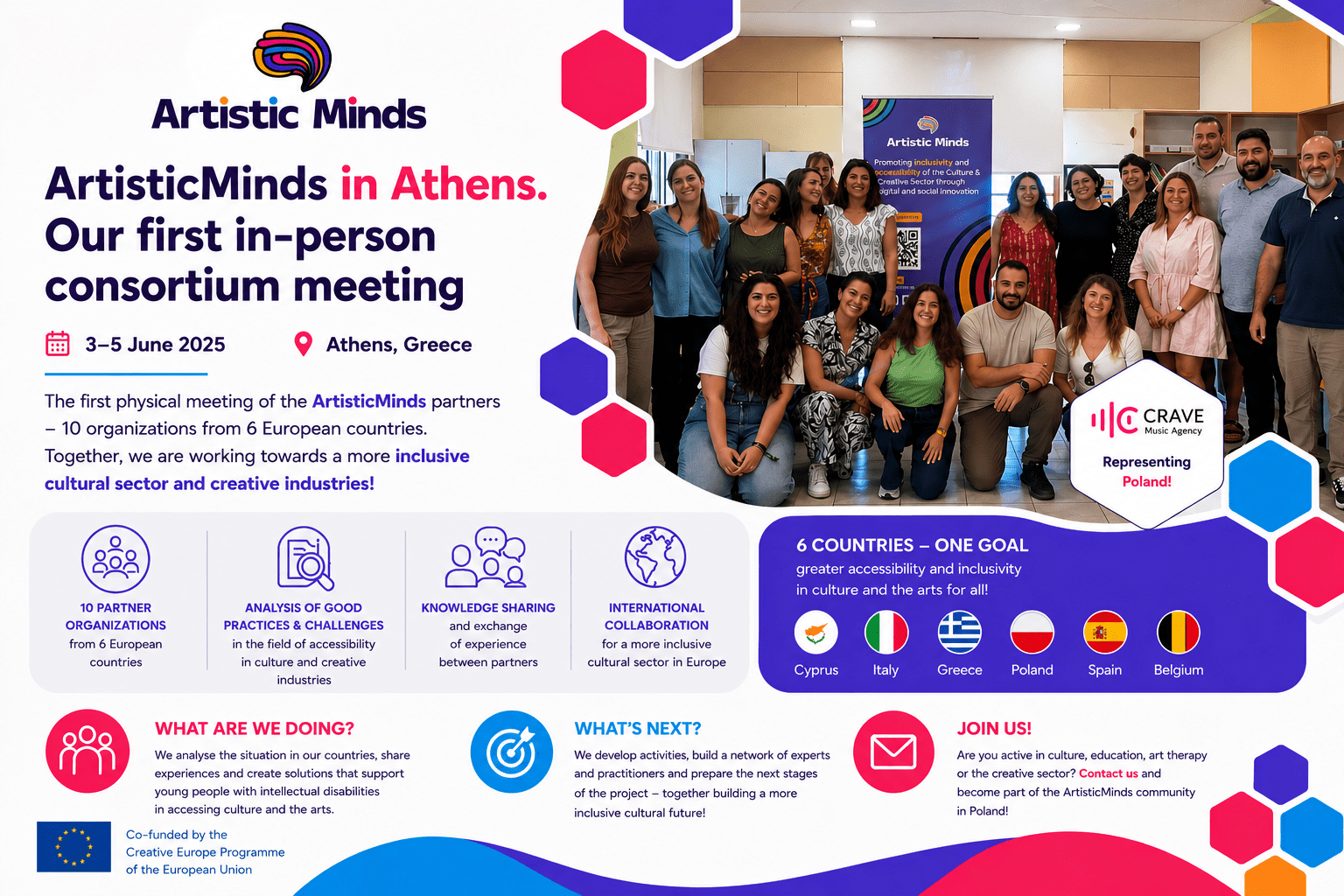
June 3–5, 2025. Study Visit, peer review, mapping of national CCS programmes. CRAVE as the Polish presence in the 10-organisation, 6-country consortium.
What it was
On June 3–5, 2025, the ArtisticMinds Study Visit took place in Athens — the first major in-person consortium meeting after January’s online kick-off. Partners from 10 organisations in 6 countries traveled to Athens for three days of exchanging good practices and peer-reviewing what’s been mapped in the project’s first phase.
What a Study Visit is for
A Study Visit isn’t a conference, and it isn’t a workshop. In project terminology, it’s a WP2 (research/mapping) tool — the moment when the consortium physically meets, each partner shows a slice of their fieldwork, and together we identify the gaps and needs to be addressed by the project.
In ArtisticMinds specifically:
- each partner presented national CCS (Cultural and Creative Sector) programmes for young people with intellectual disabilities
- well-being came up as a dimension of those programmes — because artistic work with people with intellectual disabilities isn’t separable from work on their wellbeing
- peer review = other organisations feedback the map, point out blind spots, ask questions
- output: an updated gaps-and-needs list as the basis for further WP2 deliverables
Three days in Athens
The Study Visit format is not arbitrary. Three days is long enough to close a mapping → peer review → discussion → next steps cycle, but short enough to keep a 20–30-person group focused in an intensive mode. Plus — importantly — long enough for partner groups to have time for informal conversations between sessions.
In EU projects this “second track” of conversations (over coffee, at dinner, walking from hotel to venue) often carries more weight than the formal agenda. That’s where the actual decisions get made about who’s doing what next quarter and which gaps in the ArtisticMinds map a particular partner will close.
From the Polish side
CRAVE in Athens represented the Polish side of the project — bringing the national context: what programmes exist (or don’t), what gaps show between institutional offer and field practice, where ArtisticMinds might bring something others won’t propose. This kind of exchange is our favourite part of EU projects: information mixes that you wouldn’t find in any single research paper.
In Athens we spoke to Italian and Spanish partners about their support models. Each country has its own legal, institutional and financial conditions — a comparative analysis lets you see what works in contexts where you (yet) don’t operate.
What’s next
The next stage is national-level networking. Each partner — including CRAVE in Poland — has the task of assembling a pool of professionals: practitioners working with young artists with disabilities, plus CCS experts who’ll be involved in developing and implementing the project’s next modules.
The Polish pool is starting from the people we already worked with at the May 28 inauguration at Sztukarnia — and we’ll be expanding it. If you work in this area and want to be part of it, email: [email protected].
Stay up to date with the project
The project website with updates from the consortium, social media with coverage from meetings and events, plus the newsletter with focused updates on WP2 and WP3 deliverables.