
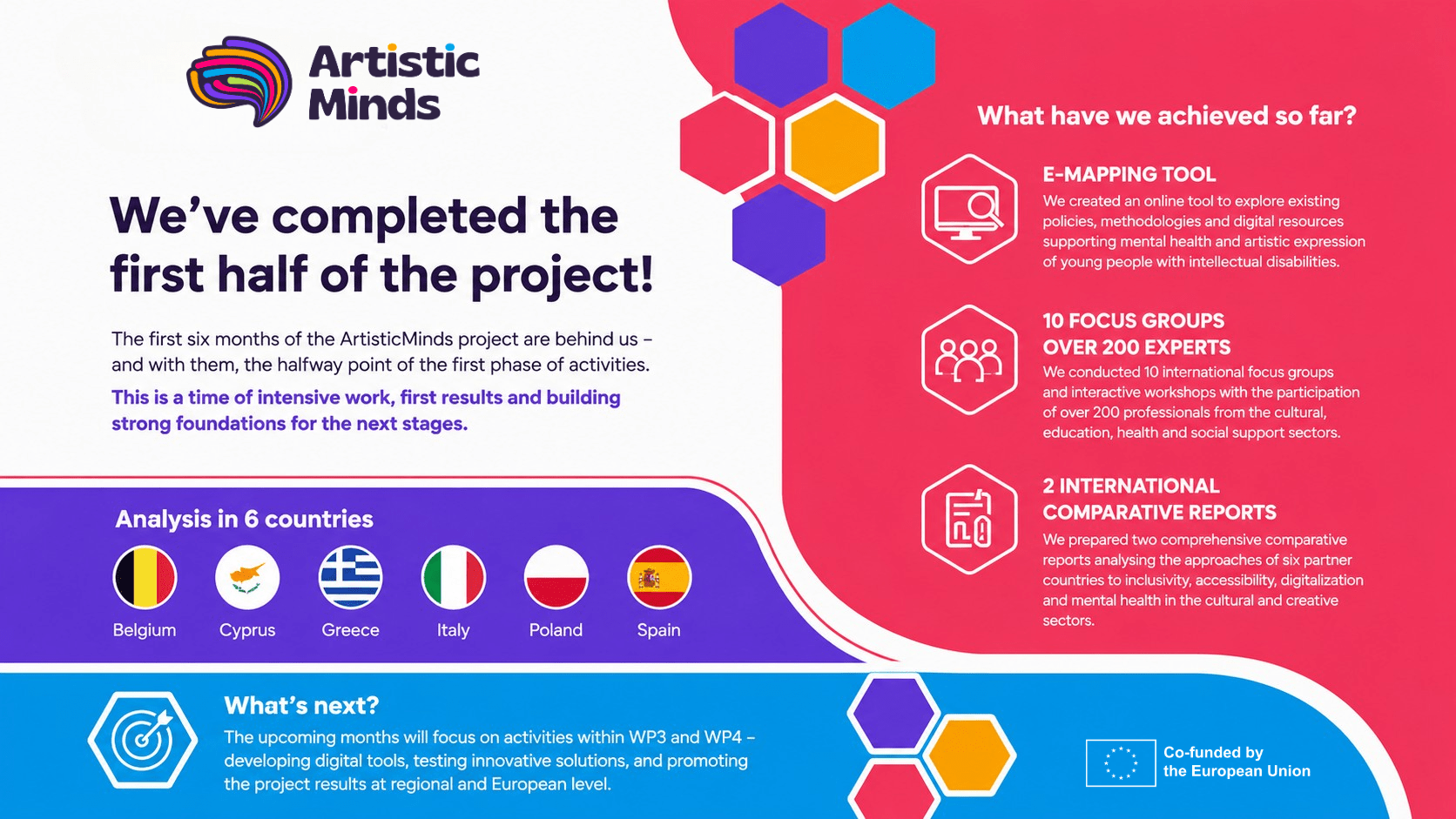
The first six months of the project are behind us – and with them, the halfway point of phase one. In that time, three key WP2 outputs have started to take real shape: we ran analyses across six countries and engaged over 200 professionals in international focus groups.
What this moment is
The first six months of the ArtisticMinds project are behind us — and with them, the halfway point of phase one. It’s the moment when a project stops operating purely at the level of concepts and timelines, and starts translating into concrete outputs, tools, and working models that can have real applications beyond the project itself.
For ArtisticMinds, that means above all the development of three key WP2 deliverables, parallel analyses across six countries, and the engagement of more than 200 professionals and stakeholders in international focus groups.
E-Mapping Tool
One of the most important outputs of phase one is the e-mapping tool available on the ArtisticMinds website. It lets users browse existing policies, methodologies, and creative digital resources supporting mental health and artistic expression among young people with intellectual disabilities.
In practice, it’s a structured knowledge base where organisations, practitioners, and funders can find inspiration, proven solutions, and examples of activities that can be replicated in their own countries or projects. It’s also a source of data and good practices that can support the development of further initiatives and new grant applications.
Tools of this kind are often underrated, but in reality they’re one of the most lasting and useful traces left by projects funded under EU programmes.
10 focus groups, 200 experts
The second pillar of the work to date was running 10 international focus groups and interactive workshops with around 200 participants — both professionals working with young people with intellectual disabilities and neurodivergent people, and experts representing the cultural and creative sector (CCS).
It’s a scale that allows us not just to collect individual perspectives, but to compare experiences, identify shared challenges, and draw broader cross-cutting conclusions at the international level.
CRAVE, as the sole Polish partner in the ArtisticMinds consortium, was responsible for delivering the national part of the research. The findings and recommendations gathered will form the foundation for the next deliverables developed under WP3 and WP4.
Two cross-national reports
The third deliverable — the most analytical, but also one of the most project-critical — is a pair of cross-national reports. They analyse how six partner countries — Belgium, Cyprus, Greece, Italy, Poland, and Spain — approach inclusion, accessibility, digitalisation, and mental health in the cultural and creative sector.
Comparative analysis of this kind, carried out on one’s own, would require significant research capacity and many months of work. In European cooperation projects the process runs in parallel — each partner is responsible for analysing their own country, and the results are then combined into a single document showing a broader, European perspective.
This is where one of the greatest values of Creative Europe projects emerges: the chance to directly compare solutions operating in different countries and to put one’s own practices alongside the experiences of partners from other parts of Europe. It makes it easier to see both local strengths and areas that still need development.
From the Polish side
In phase one, CRAVE was responsible for coordinating and delivering the Polish part of ArtisticMinds. This covered both research and content work, as well as activities related to communication and local project implementation.
- participation in the international Kick-off Meeting in January 2025 and the Athens Study Visit in June 2025,
- organising the Polish Launch Days — the May 28, 2025 meeting at Sztukarnia with an art therapy workshop,
- preparing the Polish input into the cross-national reports, covering programmes, policies, and practices operating in Poland,
- delivering the Polish part of the focus groups with CCS experts and specialists working with people with intellectual disabilities and neurodivergent people,
- ongoing project communications and promotion of ArtisticMinds activities on the Polish market.
What’s next
The coming months of the project will focus primarily on activities delivered under WP3 and WP4. The next stage will involve the development of components related to digital innovation, new tools supporting inclusion, and further promotion of project outputs at regional and European level.
The consortium also faces a stage of implementation, testing of the solutions developed, and further expansion of the cooperation network between partners and the cultural sector.